No content results match your keyword.
Content
You have successfully logged out.


Surgical site infections
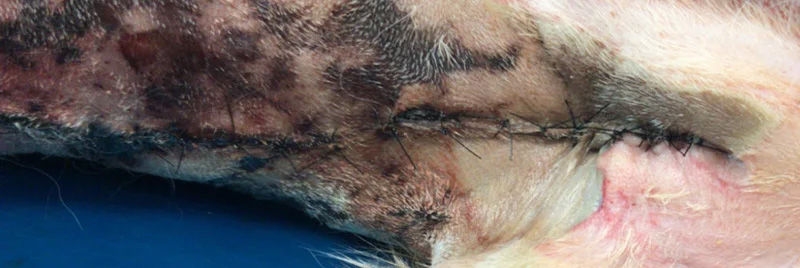
Surgical site infections are a nightmare for any surgeon. They are the main cause of surgical complications and surgical failure. For the patient, SSIs can entail prolonged hospitalization, additional treatments, morbidity and mortality. For the owner, this often entails emotional stress and added financial burden.1
Surgical site infections occur when microorganisms penetrate and get into surgical wounds. These microorganisms may come from endogenous flora from the patient itself, but may also result from exogenous contamination that comes from people present in the operating room, transfer from hands, or airborne transmission.
The manifestation of surgical site infections ranges from asymptomatic rapid elimination of the contaminating pathogens, to local reddening of the skin around the sutures, right up to aggravation and infection of the soft tissue with possible spread and even sepsis.2
The following factors decisively affect SSI rates:3
Wound infections are classified as follows according to the CDC and NRZ (National Reference Center for Surveillance of Nosocomial Infections in Germany): superficial, deep and body cavity/organ infections.
Infection post surgery | ||
| at the incision site involving only skin or subcutaneous tissue | at the incision site including the fascia and muscle tissue | including organs or body cavities that were opened or manipulated during the operation |
and | ||
| initial symptoms of infection within 30 days of surgery | first symptoms of infection within 30 or 90 days post surgery depending on the type of surgery | |
and at least one additional criterion | ||
| Purulent secretion from the superficial incision | Purulent secretion from deeper down | Purulent secretion from drainage with access to the operating area |
| Detection of pathogens from aseptically removed material of the incised/subcutaneous tissue | All three of the following: 1. One symptom: fever (>39.5°C) or pain or sensitivity to touch and 2. Spontaneous dehiscence/conscious opening and 3. Detection of pathogens | Detection of pathogens in aseptically removed material |
| One of the following (although no negative microbiological examination may be present): - Pain/sensitivity to touch - localized swelling - reddening/overheating and - intentional opening of the incision | Abscess or other signs of infection (determined e.g., during surgery, examination, imaging) | Abscess or other signs of infection (determined e.g., during surgery, examination, imaging) |
| Wound infection diagnosis by treating physician | Wound infection diagnosis by treating physician | Wound infection diagnosis by treating physician |
| Superficial post-op wound infection | Deep post-op wound infection | Post-op body cavity/organ infection |
| (Simplified representation according to KISS NR-hygiene.de) | ||
In veterinary medicine, the postoperative wound infection rate is between 0.2 and 8 percent4–10 for small animal medicine while in horses, an SSI incidence of up to 50 percent has been reported.11
The number of unreported cases can be considerably higher as there is no proper recording/monitoring (surveillance) of surgical site infections in veterinary medicine, also over longer periods of time (30 or 90 days).10
Related information
Surgical site infections
Learn moreNot all SSIs are preventable, but they can be reduced to a minimum thanks to strict asepsis and targeted prevention.12


