You have successfully logged out.

Monosyn® Quick – The fast one

Fast and monofilament

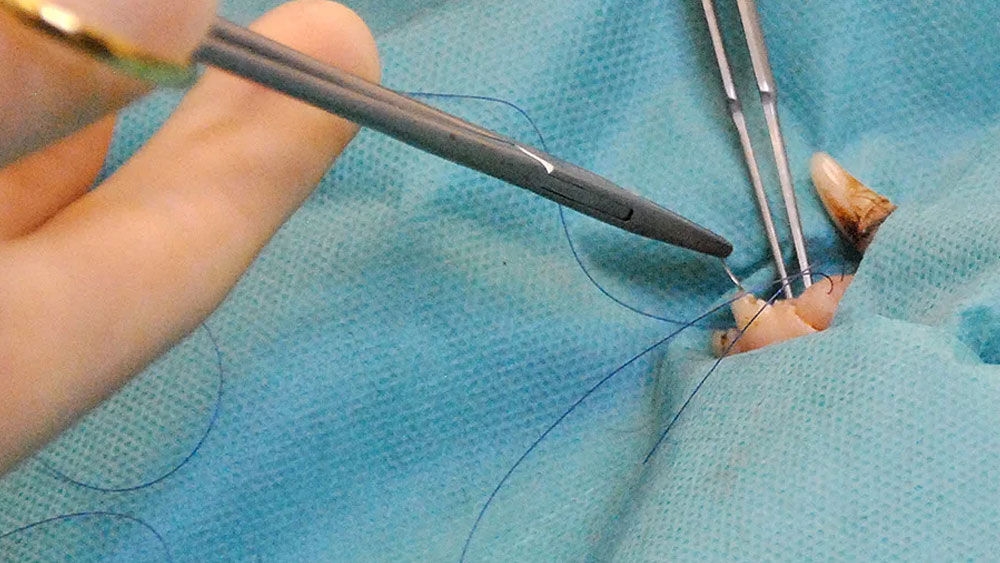
Monosyn® Quick is a short term resorbable and monofilament suture material. Due to its short resorption time, Monosyn® Quick is used in veterinary practices and clinics, especially in dental surgery and for sutures of the mucosa. With its good elasticity and flexibility in combination with reliable knotability, Monosyn® Quick is particularly well suited for wounds which require only short support.

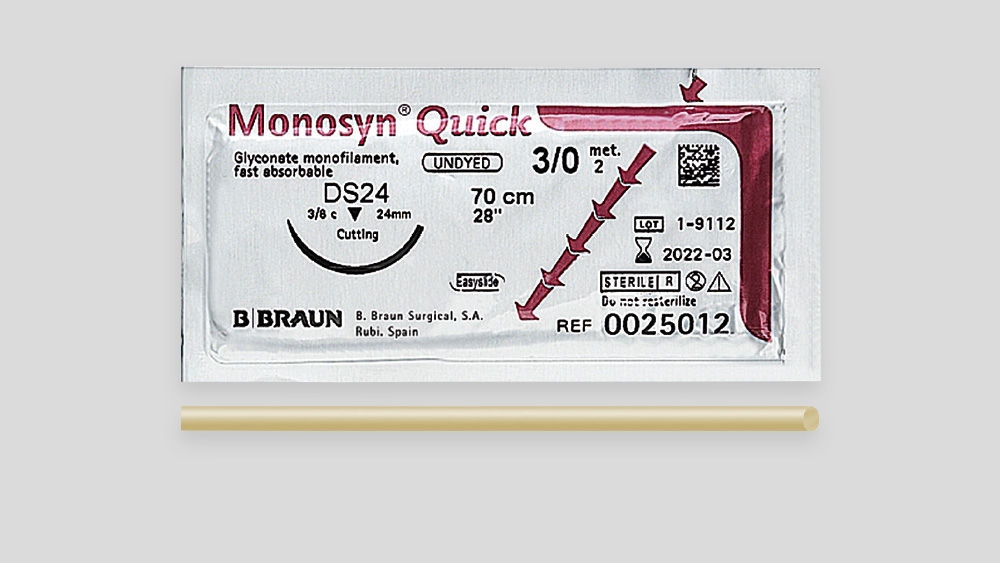
Monosyn® Quick absorbable suture packaging showing the product label with thread size (USP 3/0), needle type, suture length, CE marking, and B. Braun branding, with the suture thread displayed below the package
Structure:Monofilament, uncoated
Chemical composition:Gylconate
Diameter:USP 6/0 - USP 1
Colour:undyed
Absorption time:~ 6 - 7 days
Knot tensile strength retention:~ 6 - 7 days p. i. 50 %
Mass absorption:~ 56 days
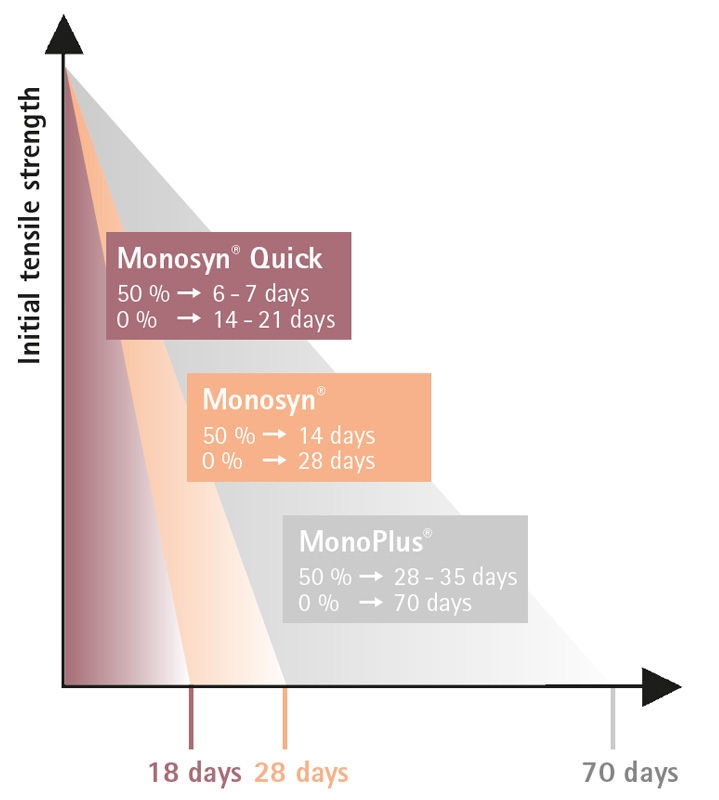
 Infographic titled ‘Tensile strength retention of the B. Braun synthetic suture for fast healing tissues’. On the left, explanatory text lists three absorbable sutures: Monosyn® Quick, described as a short-term absorbable suture for fast healing tissues; Monosyn®, described as a mid-term absorbable suture for soft tissue approximation; and MonoPlus®, described as a long-term absorbable suture designed for slow healing tissues.  On the right, a stepped bar diagram shows tensile strength retention over time. The vertical axis is labeled ‘Initial tensile strength’. Three color-coded layers are displayed from top to bottom:  – Monosyn® Quick, indicating approximately 50% tensile strength remaining after 6–7 days and 0% after 14–21 days.  – Monosyn®, indicating approximately 50% tensile strength remaining after 14 days and 0% after 21–28 days.  – MonoPlus®, indicating approximately 50% tensile strength remaining after 28–35 days and 0% after around 70 days.  A horizontal time scale at the bottom highlights key points at 18 days, 28 days, and 70 days, illustrating the increasing duration of tensile strength retention from short-term to long-term absorbable sutures.

Related Documents

  • Catalog Suture Material and Special Products

    Complete provision for the surgical practice

    link

  • Overview Pick a Color

    The right thread for every suture

    link

  • Pocket Guide The Right Thread for Every Suture

    Good to know B. Braun sutures

    link

  • Suture Recommendations B. Braun

    The perfect thread for every suture

    link

References

  1. Mangram AJ, Horan TC, Pearson ML, Silver LC, Jarvis WR. Guideline for Prevention of Surgical Site Infection, 1999. Centers for Disease Control and Prevention (CDC) Hospital Infection Control Practices Advisory Committee. Am J Infect Control. 1999;27(2):97-132.
  2. Choi HJ, Chae HD. Comparison of E. Coli infiltration between new synthetic absorbable sutures. J Korean Surg Soc. 2009;77(1):1-6.
  3. Buresch A, Van Arsdale A, Ferzli M, Bernstein P, Garry D, Ngai I. Comparison of subcuticular suture type in post-cesarean wound complications: A randomized controlled trial American Journal of Obstetrics and Gynecology. 2017;216:1 Supplement 1 (S25).
  4. Won H-S, Lee S-W, Kim Y-M, Kim A. Clinical usefulness and safety of the anti-bacterial coated multi lament suture (Vicryl Plus®) and mono lament suture (Monosyn®) in hysterectomy BJOG: An International Journal of Obstetrics and Gynaecology. 2012;119 SUPPL. 1 (44)
  5. Im JN, Kim JK, Kim HK, Lee KY, Park WH. Characteristics of novel monofilament sutures prepared by conjugate spinning. J Biomed Mater Res B Appl Biomater. 2007;83(2): 499-504.