Fig.: Ideal – No jewelry or nail polish, fingernails end at the fingertip
You have successfully logged out.


Hand hygiene
A handshake when greeting someone, the opening of a door, the grabbing of a bill from your wallet – we spread germs and expose ourselves to them every day as a matter of course. On our hands alone, there are approximately 10 million potentially pathogenic microorganisms – an impressive number that makes hands a significant risk factor.
In addition to normal skin flora, there are also multi-resistant germs including S. aureus, S. pseudintermedius, Pseudomonas spp., and Enterobacteriaceae present on the hands of veterinary staff.1
Hand hygiene poses major challenges for every veterinary practice, every veterinary clinic, and every other veterinary institution – while at the same time offering enormous potential for improvement in hygiene management. By specifically improving hand hygiene, a significant 40 percent reduction in hospital-associated or hospital-acquired infections (HAI/NI) can be achieved.2, 3
Hand hygiene compliance (ensured according to the 5 moments for hand hygiene) in veterinary medicine is well below the average value compared to human medicine at 14 - 36 percent.4, 5 It can therefore be assumed that there is even greater potential for reducing hospital-acquired infections in veterinary medicine. The average contact time is also often too short for surgical and hygienic hand disinfection.4, 5
This means that hand hygiene is one of the most important measures for counteracting HAI/NI.6 It should therefore be an integral part of everyday routine in veterinary practices and clinics.
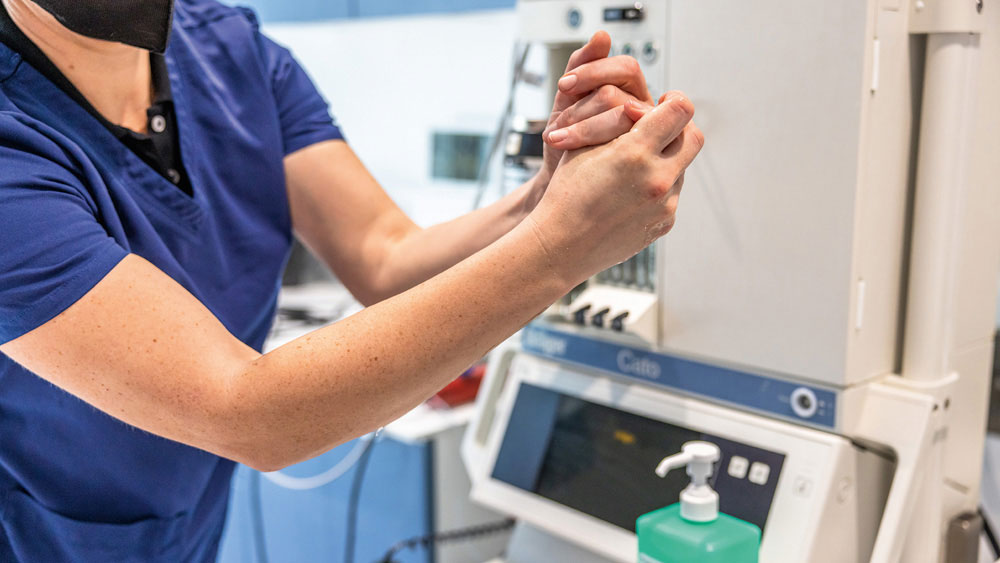
These points show us how much life truly is in our hands at times. Our desire is to help veterinary health care facilities to truly take advantage of this prevention potential. Here, the goal is to work on staff compliance with regard to hand hygiene.

The hands are the most important tools for staff in veterinary practices and clinics. This is precisely why they are also the most common route of transmission for hospital-acquired infections. Effective and simple protection against nosocomial infections is provided by correctly performed hand disinfection. You can find all the necessary steps in detail in our step-by-step guide on hygienic hand disinfection.
In the event of possible contamination with viruses, it must be ensured that the product to be used has a wide spectrum of effects and is effective against the corresponding viruses.
Fig.: Ideal – No jewelry or nail polish, fingernails end at the fingertip

Fig.: Best avoided – Jewelry and artificial fingernails, fingernails that go beyond the fingertip
In order to ensure comprehensive hand hygiene, dispensers should be provided in the immediate vicinity and should be regularly filled/reprocessed in a documented manner. Bottles of hand disinfectant are only used as single-use products and must bear the date of opening.
Learn more
Whether preparing for surgery or during surgery: Minimizing risks is always one of the top priorities in all hygiene measures. Correct hand disinfection – that of the operating surgeon, as well as that of all other persons involved in the operation – is essential in order to avoid possible infection of the patient during a procedure. Therefore, surgical hand disinfection must aim to reduce transient and, above all, resistant skin flora as far as possible and for as long as possible. All necessary steps are described in detail in our surgical hand disinfection step-by-step guide.
A pH value of 5.5 and a relatively low moisture content – healthy skin has good growth conditions for the predominantly gram-positive bacterial flora. This flora is referred to as resident flora. Resident germs are characterized by their special adhesive properties. They mainly colonize the upper layers of the stratum corneum (horny skin layer) as well as the upper parts of the hair follicles and sebaceous ducts. Approximately 20 percent of microorganisms can still be detected in layers deeper than 0.3 mm. This microbial flora does not normally harm a healthy person; however, it does pose a risk to wounds and thus to patients and can only be reduced by surgical hand disinfection. Compared to hygienic hand disinfection, surgical hand disinfection therefore requires a longer contact time for it to reach the deeper layers.
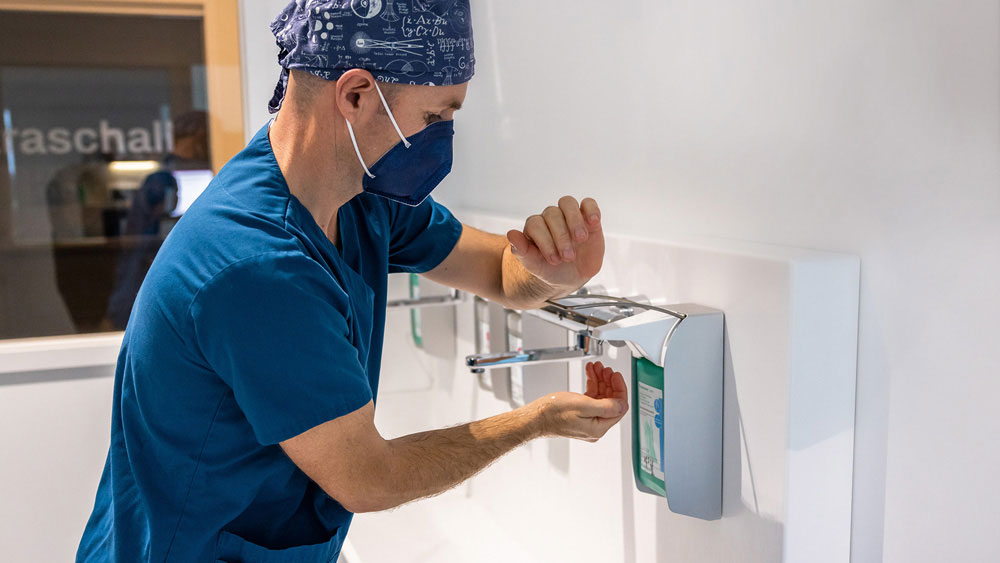
Frequent hand cleansing removes protective lipids from the skin and impairs the skin’s natural barrier function. For this reason, unnecessary hand washing should be avoided. Hand washing should be carried out in accordance with the AWMF Hand Hygiene guidelines:
Hands are washed under running water. The elbow is used to dispense the skin-gentle hand wash from the dispenser. The agent is rubbed into the hands, the hands then get rinsed under running water and are then carefully dried with a disposable towel.
Frequent washing and disinfection, constant contact with different substances, or frequent wearing of latex gloves – professional activities and increasing external aggravations can lead to high levels of strain on hands and skin. Skin problems are increasingly common as a consequence. Occupational skin diseases have increased significantly in recent years and now occupy the top position on the list of reported occupational diseases. One thing is clear: injuries, eczema, and other skin diseases are not just a purely esthetic problem. They are of high hygienic relevance. For this reason, skin protection, skin cleansing and skin care are considered an essential part of occupational health and safety and are described in the General Prevention Guidelines for Skin Protection of the DGUV (German Social Accident Insurance).
The use of preparations for skin protection is particularly important for wet work and particularly for skin-stressing activities. Protective measures strengthen the skin’s resilience. The employers’ liability insurance association recommends using skin protection products:
And to use liquid product from a dispenser whenever possible.
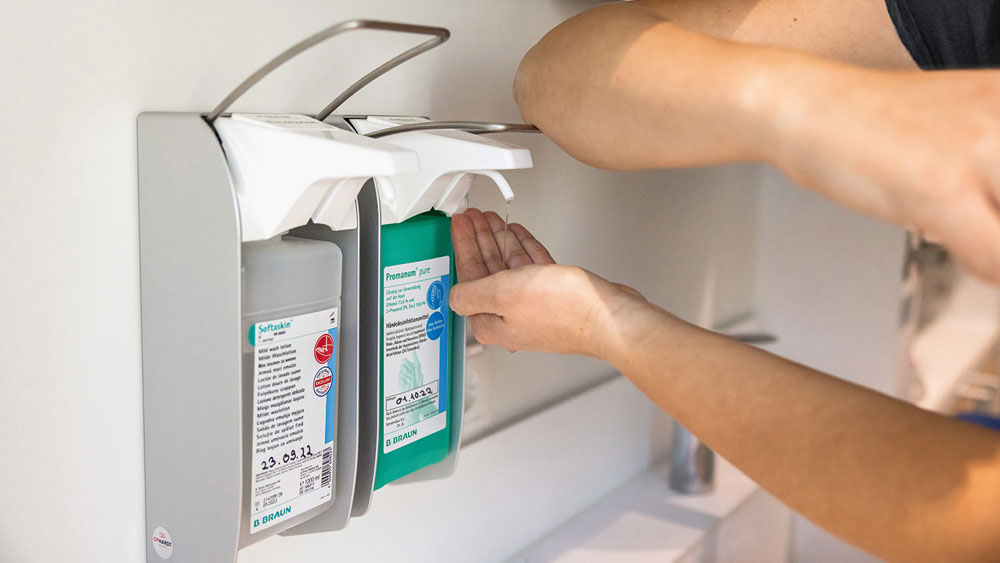
In order to minimize hand washing and disinfection effects on the skin from, it is important to ensure sufficient skin care. However, this does not just concern employees wishing to avoid burdensome skin irritation and diseases: damaged hands can no longer be sufficiently disinfected because germs nest in the damaged areas of the skin and are therefore no longer accessible for the disinfectant. Even the smallest cracks and microtrauma are sufficient to allow the risk of transmission of pathogens to increase.
To minimize this risk, skin care should be performed:
Hygienic hand disinfection
Step-by-step guide
link
Virucides: Spectrum of efficacy / Pathogens / Diseases
Practical tip
link
5 Moments for hand disinfection
Poster
link
Surgical hand disinfection
Step-by-step guide
link
Hand washing
Step-by-step guide
link
Wall dispenser reprocessing
Practical tips
link